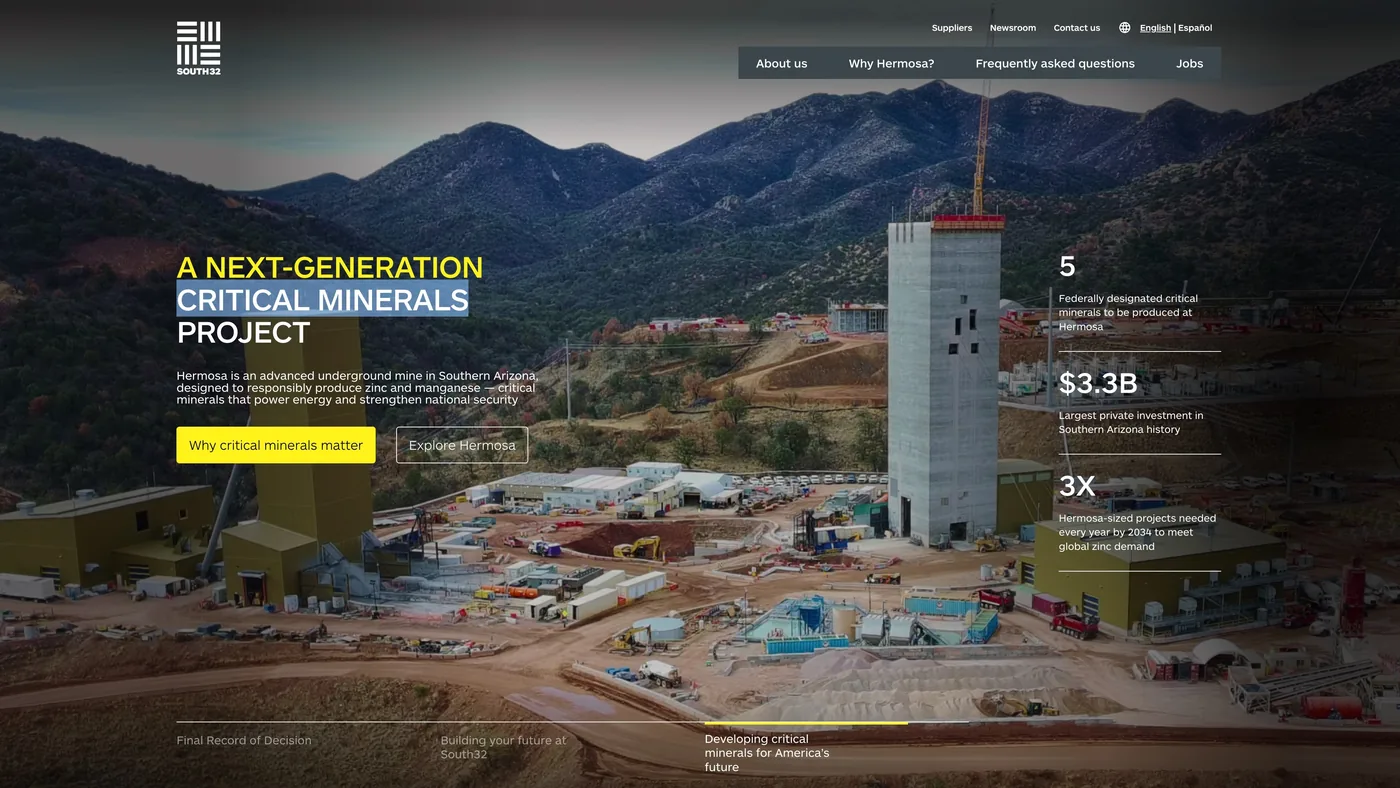
On 2 September 2026 the Permitting Council announced that the South32 Hermosa Critical Minerals Project had completed federal environmental review and permitting. It is the first mining project covered by FAST‑41 — the co-ordinated federal permitting process created by the Fixing America’s Surface Transportation Act of 2015 — to finish that process from end to end.
Hermosa is an underground operation in Santa Cruz County, Arizona, about 55 miles south of Tucson, with the US Forest Service as lead agency. The Permitting Council’s own dashboard records it as a covered project since 5 May 2023 and shows four of four environmental review and permitting processes completed, with a completion date of 2 September 2026. That is a little under three years and four months on the federal dashboard.
For scale, the Department of the Interior’s own statement of the problem, published when it added five mining projects to FAST‑41 in April 2025, was that permitting “can stretch seven to 10 years for a single mine.”
The manganese is the part worth noticing
The project is described as producing up to five federally designated critical minerals, including zinc, silver and manganese. The zinc resource is among the largest undeveloped ones anywhere. But the manganese is the number that should stop a reader of this site.
The US Geological Survey’s Mineral Commodity Summaries 2026 records US manganese mine production as nil for every year from 2021 through its 2025 estimate, and net import reliance at 100% for each of those years. The line in the survey is plain: “Manganese ore containing 20% or more manganese has not been produced domestically since 1970.” Imports of manganese ore over 2021–24 came from Gabon (64%), South Africa (24%) and Mexico (12%).
Manganese is not exotic. It goes into almost all steel, and into the cathode of a large share of lithium-ion batteries. The United States has not mined its own since the year the first Boeing 747 entered service.
What was actually approved
The Permitting Council put the project’s investment at $3.3 billion and the jobs at approximately 900 direct positions. South32 has described a construction programme above $2 billion, with underground mining scheduled to begin in late 2027 and first production in early 2028.
What this changes
One project completed one process. FAST‑41 co-ordinates federal agencies and publishes a binding timetable; it does not lower a standard or remove a review, and it does not touch state or local permitting at all. The honest claim is narrower than the headline: a co-ordinated schedule was applied to a mine, and the mine got an answer in a bit over three years rather than seven to ten.
And a permit is not a plant. Hermosa will produce concentrate. Whether the manganese in it is turned into battery-grade material in the United States or shipped somewhere that already has the capacity is a separate question, decided by a separate set of facilities that mostly do not exist here — which is the argument this whole site is making.