
An executive order can be undone by the next president with a pen. A statute cannot. That is why the most durable thing happening in federal minerals policy right now is not another order — it is Congress copying the orders into law.
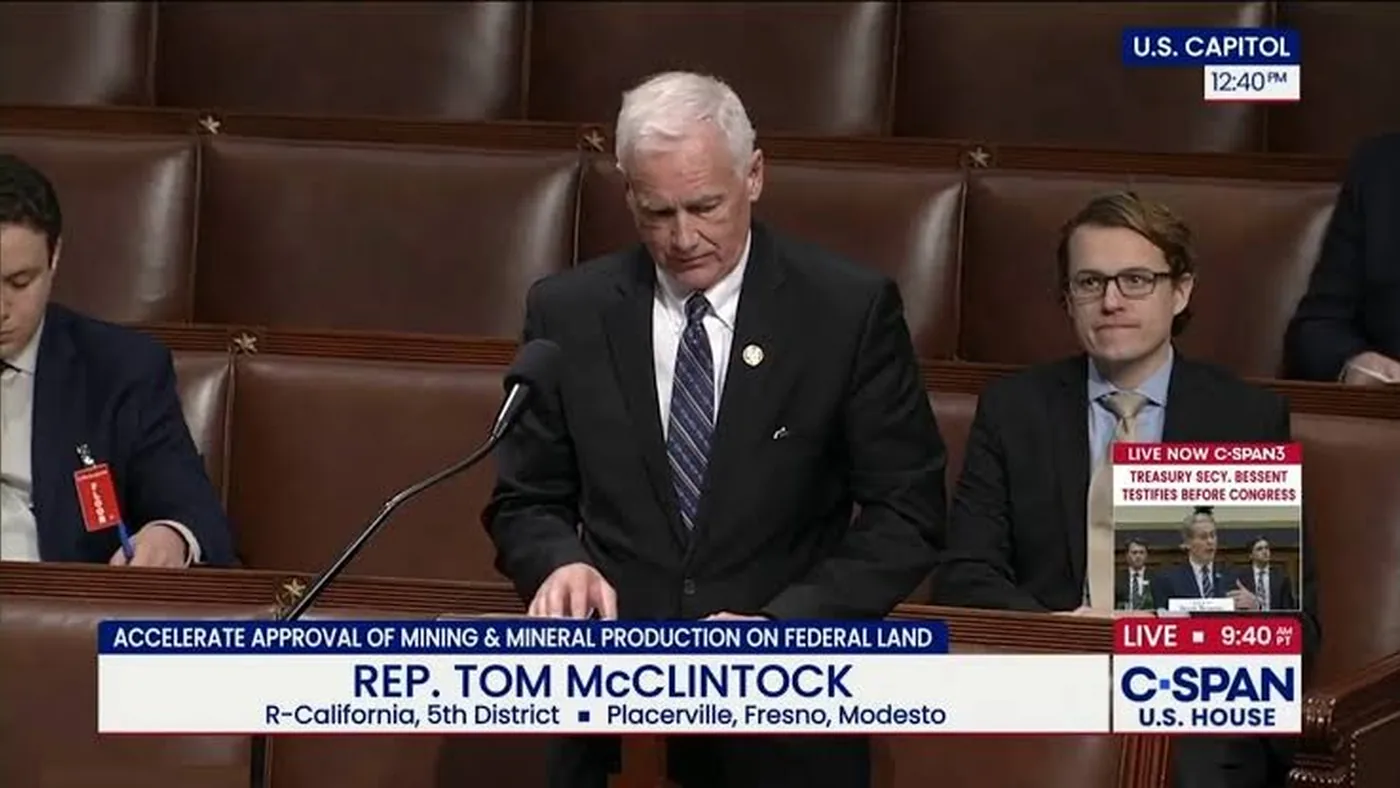
On 4 February 2026 the House passed H.R. 4090, the Critical Mineral Dominance Act, sponsored by Rep. Pete Stauber of Minnesota, by 224 votes to 195. The House Natural Resources Committee describes it as a bill that “codifies multiple EOs that relate to hardrock mining” — specifically provisions of Executive Orders 14154, 14241 and 14272.
What the bill does
Three things, by the Republican leadership’s own legislative digest. It creates a list of minerals the United States relies on imports for, with the dollar value and economic impact of that reliance attached. It directs the Interior and Agriculture departments to identify mining projects and sites to expedite or expand, ranked by how quickly they could come online and cut import reliance. And it makes geologic mapping a priority at Interior, aimed at hardrock deposits not previously known.
The committee adds that the bill directs Interior to alter or cancel agency actions that obstruct domestic mining, speed approvals for existing mines on federal land, and report to Congress on obstacles to US mining with suggested statutory fixes.
Every one of those is about getting rock out of the ground, or about knowing where rock is. None of them is about what happens to the rock afterwards.
The aspiration and the text
The gap shows in the quotes. Stauber’s own statement describes the goal as making the United States a place to “mine, process, and refine the critical minerals needed to compete and win in the 21st Century.” Chairman Westerman used the same three verbs. The bill, as described by the committee and the leadership digest, carries the first one.
That is not a hidden flaw — the bill is named for mineral dominance and it does what a mining bill does. It is simply worth noticing that the rhetoric reaches to the refinery and the text stops at the pit.
The one place statute touches the middle
There is an exception, and it came earlier. On 18 December 2025 the House passed H.R. 1366, the Mining Regulatory Clarity Act of 2025, sponsored by Rep. Mark Amodei of Nevada. It creates a new category of mill sites so that operators can use federal land for ancillary activities tied to mining, and sets up an Abandoned Hardrock Mine Fund for reclamation, funded from claim maintenance fees.
Mill sites are the land a mill, a tailings facility or a processing plant physically sits on. The bill is a response to a 2022 Ninth Circuit decision in the Rosemont copper case, which constrained the Forest Service’s ability to approve mining support activities on federal ground. The Senate companion, S. 544, from Sen. Jim Risch of Idaho and Sen. Catherine Cortez Masto of Nevada, cleared the Senate Energy and Natural Resources Committee on 9 April 2025.
So the one statutory thread that reaches the middle of the chain is about where a plant may stand — and even that is framed as support for mining rather than as processing capacity in its own right. It is a land question, not a furnace question.
What this changes
Nothing yet, in the strict sense: a bill that has passed one chamber is not law. Chairman Westerman said the vote “sets the stage for Senate action,” which is a fair description of where it sits.
What it tells you is what Congress currently means by minerals policy. Faster approvals, better maps, a ranked list of projects, and clearer rights to the ground a mill stands on. If you believe the binding constraint is the number of mines, that is the right package. If you believe the constraint is that 26 copper mines feed two smelters, it addresses the wrong end — and the party speeches around the vote name the right end without legislating it.