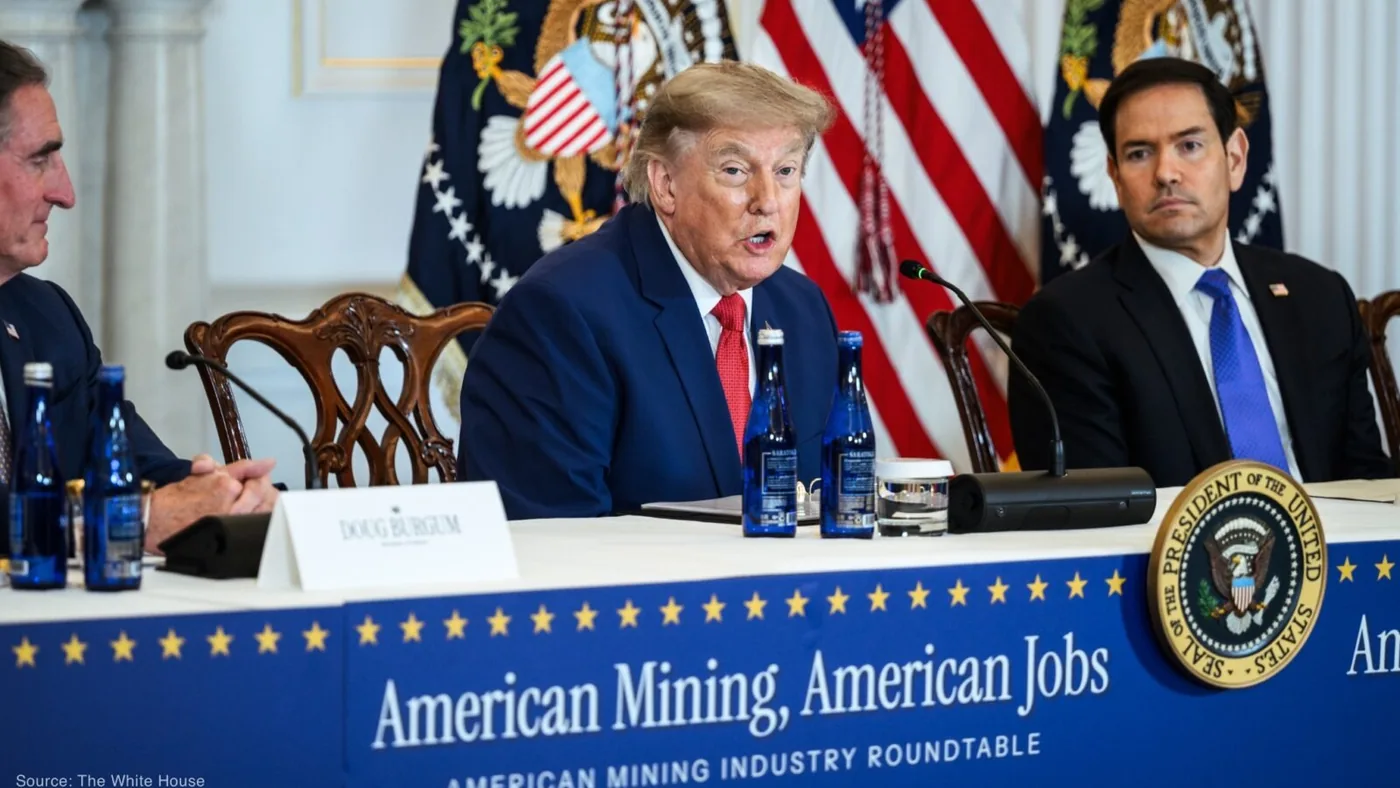
On 7 August 2026 the White House published a fact sheet announcing what it described as over $2 billion in critical mining and mining-related projects, plus over $180 million for mining schools. The money comes from three places: the Department of War, the Export‑Import Bank, and the Development Finance Corporation. The interesting part is not the total. It is what each line buys.
The ledger
Department of War. Over $85 million to Strategic Bauxite for a refractory-grade bauxite supply chain. $150 million to Niron Magnetics in Minnesota for rare‑earth‑free permanent magnets. $1.4 billion to Sila Nanotechnologies in California for silicon-carbon battery anodes and a lithium-ion cell facility. $400 million to Sunrise Energy Metals for a full scandium value chain, including what the fact sheet calls “the world’s first primary scandium mine.”
Export‑Import Bank. $8 million to 5E Advanced Materials for a boron deposit in California. $25 million to Westwater Resources for the Coosa graphite deposit in Alabama. $25 million to Global Advanced Materials in Pennsylvania for tantalum and niobium.
Development Finance Corporation. $4.8 million in matching finance to Harena Rare Earths for a rare earth mine — in Madagascar.
Workforce. $100 million from the Department of Energy to America’s fourteen mining schools, and over $80 million from the Department of War to three more for workforce programmes and technology hubs.
Sorted by what it builds
Four of the lines are mines or deposits: bauxite, boron, graphite, Madagascar rare earths. Two are factories that sit downstream of smelting and refining — Sila’s anode and cell facility, which at $1.4 billion is by far the largest single item on the list, and Niron’s magnet plant. Scandium spans mining and processing. Tantalum and niobium are ambiguous from the fact sheet’s own description.
Line them up in the order material actually moves — mine → smelter and refinery → factory — and the shape of this announcement is plain. The mines are funded. The factories are funded, and generously: the largest single cheque, $1.4 billion, builds a battery-materials plant in California, and $150 million builds a magnet plant in Minnesota.
The step between them gets nothing. Not one dollar in this announcement goes to a copper smelter, a nickel refinery, a lead refinery or a precious-metals refinery — the plants that take concentrate from an American mine and turn it into metal.
That gap is the whole problem, because the funded factories sit downstream of the unfunded step. A magnet plant needs refined rare earth metal before it can press a magnet; an anode plant needs refined material before it can coat anything. With no refinery here, those new American factories buy their refined input from the same foreign plants the old ones did. The detour is not removed. It is moved one step closer to home.
One line worth checking
The $400 million for Sunrise Energy Metals appears under a fact sheet headed “to power American mining,” and the fact sheet does not state a location for it. Trade press reporting of the same date and the same amount describes a conditional commitment from the Pentagon’s Office of Strategic Capital of up to $400 million, as a 25‑year loan, to Sunrise’s Syerston scandium project in New South Wales, Australia, subject to financial, legal and technical conditions.
If those are the same commitment — and the date, the amount and the company all match — then the second-largest line in an announcement about American mining is a conditional loan to a mine in Australia. That may be perfectly sound policy; allied supply is still supply. It is simply not what the headline says.
What this changes
Two billion dollars is real money and most of it is going to real projects. The question is not whether Washington is spending. It is where in the chain the spending lands: on the mines, on the factories, and not on the furnaces between them.
A country can fund both ends of a supply chain indefinitely and still import the middle of it. That is what this ledger describes, and it is the one line item nobody announced.