On 19 October 2026 the Marine Minerals Administration announced the Final Leasing Notice for Lease Sale PACM‑1, scheduled for Thursday 19 November 2026. The notice was set for publication in the Federal Register the following day under public inspection document 2026‑21462, “Mineral Lease Sale American Samoa Outer Continental Shelf Pacific Sale 1.” It covers two lease areas on the outer continental shelf around American Samoa, designated OCS‑P 0568 and OCS‑P 0569.
The agency itself is new. Secretary’s Order 3451 established the Marine Minerals Administration and folded in the functions of the former Bureau of Ocean Energy Management and the Bureau of Safety and Environmental Enforcement; the notice is issued, in the agency’s own words, “under the continuing authority of the former BOEM as now delegated to MMA.”
The schedule has moved quickly by federal standards. A request for information went out in June 2025 over an area of roughly 18.1 million acres in water between about 4,600 and 20,000 feet deep. The Proposed Leasing Notice was announced on 16 July 2026 and published the next day. The Environmental Assessment is dated July 2026 and the Finding of No Significant Impact October 2026. Final notice to sale is one month.
Press reports put the two final lease areas at about 31.5 million acres combined — 16.3 million and 15.2 million. The agency’s own page does not state an acreage for PACM‑1, so that figure is reported rather than official, and it is larger than the area the 2025 request for information covered. Read it as an indication of scale, not as a number from the government.
What is actually down there
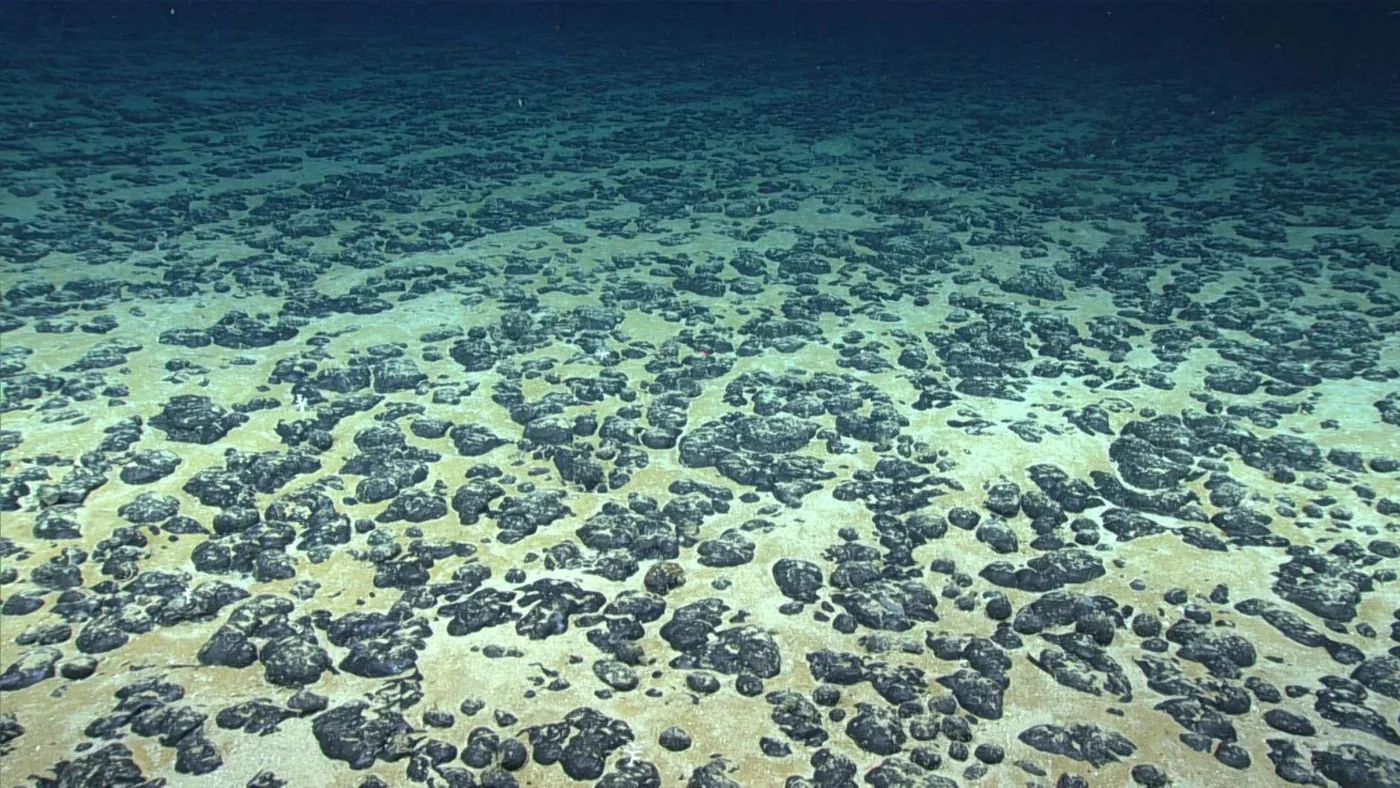
Polymetallic nodules and ferromanganese crusts. The metals of interest in them are nickel, cobalt, copper and manganese. That list is worth holding against the domestic record for each one.
The last primary nickel refinery in the United States, at Port Nickel in Louisiana, closed in 1985. Sixteen primary copper smelters became two. Manganese ore containing 20% or more manganese, in the US Geological Survey’s flat phrasing, “has not been produced domestically since 1970.” Cobalt is refined in quantity almost entirely outside the United States.
A nodule is not metal. It is a feed — a hard lump of mixed oxide that has to be broken down in a smelter or a leach circuit built for exactly that chemistry, and the plants that do it at scale are not in this country. The leasing record covers extraction, which the agency is clear needs separate federal approvals before anything is mined. It says nothing about where a nodule would be processed, because that is not what a lease sale decides.
The objection on the record
This is contested. Democrats on the House Natural Resources Committee wrote to Interior on 4 September 2026 raising concerns about the deep-sea mining plans, and scientific work on the damage caused by earlier test mining is still being published. A lease sale is a decision to offer acreage, not a finding that mining it is a good idea, and the environmental review attached to this one is an assessment with a finding of no significant impact rather than a full environmental impact statement.
What this changes
On 19 November the United States may, for the first time, sell the right to mine metal from its own seabed. That is a genuine first, and it fits the pattern this site keeps finding: the federal government is moving fast and decisively on access to rock.
The question the sale does not answer is the one that decides whether any of it becomes American metal. If a lessee lifts nodules from 15,000 feet of water in 2030, the nickel, cobalt and manganese in them will go to whichever refinery can take that feed. On today’s map, that refinery is not here. Leasing the seabed is a supply decision; building the plant that turns the haul into metal is a different decision, and nobody has announced it.